
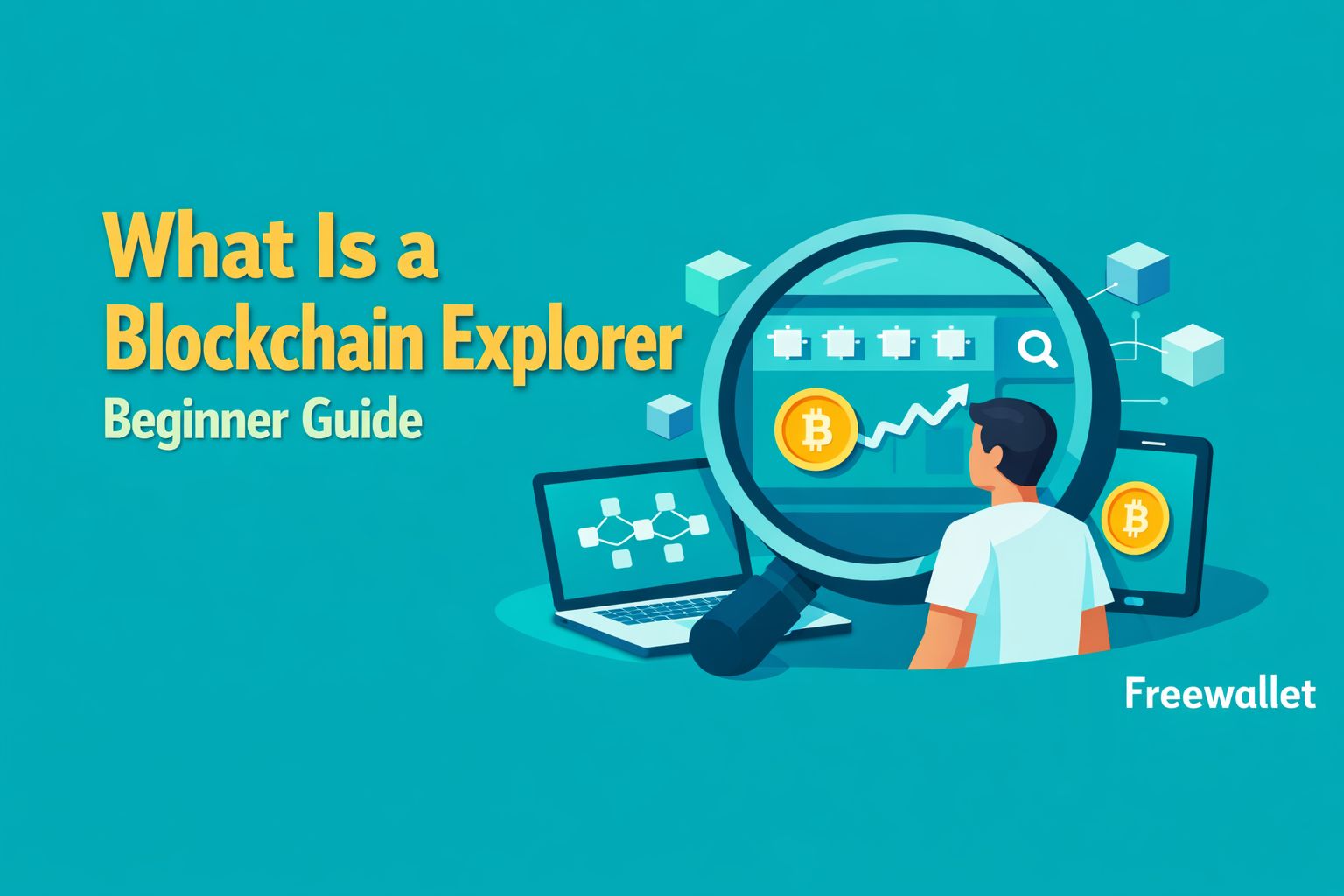
If you are into crypto, there is no doubt that you will need to check the status of some transaction, the balance in your wallet, or what happened on the blockchain. This can be done in just a few seconds using a blockchain explorer. But if you need an easier way to manage your assets and still be in control of your private keys, you can download the Freewallet Web3 Wallet.
What Is Blockchain Explorer?
But what is blockchain explorer? Blockchain explorer is a service that allows users to search and view public information on the blockchain.
If you, like many people, also ask what is crypto explorer, the answer is that it is the same thing. People often use the terms interchangeably, but blockchain explorer is the correct one. There is also the term block explorer, and people often ask what is block explorer. Well, the truth is that they all refer to the same thing.

Importance of Blockchain Explorer
The blockchain is public, but the data on the blockchain is not very comfortable to read. This is where the blockchain explorer comes in, as it helps people understand the blockchain better.
This is important because, on the blockchain, people can only see the status of their transactions as "pending" or "processing." But the blockchain explorer can show the status of the transaction as recorded on the blockchain. If people ask what is blockchain explorer used for, the best answer is verification.
How to Use a Blockchain Explorer
To use an explorer, you just have to follow a simple, repeatable process. The main rule to follow is to find the right explorer for the network.
1. Confirm the network
The transaction will only appear on one of the blockchains. That’s why the question "What are the different blockchains?" is important, as it has a different format for transactions and a different explorer.
2. Copy an identifier
You can search by a TXID, a wallet address, or a block number. If it’s a token on a smart contract blockchain, you can search by token contract address as well.
3. Paste into the explorer search bar
Open the result that corresponds to what you entered.
4. Check the status and confirmations
If it’s confirmed, it’s probably final. If it’s pending, it may not be included in a block yet.
5. Verify the key fields
Verify the sender, the receiver, the amount, and the fee. If it’s a deposit to an exchange, verify the number of confirmations as well.
Is it complicated? Let’s see two cases of how to check a transaction: TXID and wallet address.
How to Check a Transaction Hash (TXID)
The transaction hash, or TXID, is a unique identifier of a transaction. It’s a long string of letters and numbers. It’s like a tracking number.
To check a TXID:
• Copy the TXID from your wallet or exchange
• Open the corresponding blockchain explorer
• Paste the TXID into the search bar
• Open the transaction page
On the transaction page, pay attention to the following fields first:
• Status: confirmed, pending, or failed
• Confirmations: how many blocks were added after the block in which the transaction was included
• From: sender’s address
• To: receiver’s address
• Value: transaction amount
• Fee: what was paid for the transaction
• Timestamp: time of inclusion in the block
If you were wondering what is the use of crypto explorers in everyday life, this is a perfect example.

How to Track a Wallet Address and Balance
The second most common use case is looking up a wallet address.
This can be your own wallet address, a deposit address, or any other address you want to track.
To track an address, you can follow these steps:
• Copy the address
• Paste it in the search field
• Open the page
The result will most likely be a balance overview and a list of transactions.
One thing to note is that, because of privacy, a blockchain explorer will only show what is going on with an address, but it will not necessarily show who is behind the address.
Why Use a Blockchain Explorer?
The most significant advantage is speed and convenience.
Here are some of the most common reasons why users use a blockchain explorer:
• Verify a payment: know if a payment was made and received
• Track confirmations: see the status of a transaction when an exchange requires a certain number
• Troubleshoot: see what is going on with a delayed transaction
• Confirm token transfers: see what was moved in a transaction
• Review wallet history: audit your own incoming and outgoing activity
This is also where a Web3 wallet and an explorer complement each other. For instance, using the Freewallet Web3 Wallet, you can have your assets in self-custody, and then use the explorer to check the blockchain record to clear any confusion.
Popular Blockchain Explorers
There is no one explorer that works for all blockchains. Instead, the best one to use is determined by the blockchain that you used. This is the same reason that the question of what are the different blockchains is relevant, as Bitcoin, Ethereum, and Solana store data differently.
In general, the following are the types of explorers that exist:
• BTC explorers: These are the ones that focus on UTXOs, addresses, and blocks.
• Ethereum and EVM explorers: These add smart contracts, token movements, and approvals to the data available.
• Solana explorers: These add account interactions and program interactions in the Solana format.
You do not have to memorize the names of all the explorers to start using one. What you do have to do is find one that corresponds to the blockchain shown on your wallet or exchange site.

Common Explorer Terms You Should Know
There are several terms that are common to all blockchain explorers. These make the data on the explorer much easier to understand once you know what the terms mean.
Block Height (Block Number)
This is the position of the block in the chain. It is like the page number in a book. As the blocks are newer, the height is greater.
Confirmations
These are the number of blocks that have been mined since the block that contains your transaction. More confirmations, the older the transaction is, and the more confirmed it is to have happened.
Network Fee or Gas Fee
This is the fee that is required to make the transaction. It is referred to as gas on Ethereum and similar networks.
Mempool
A waiting area for transactions that have been broadcast but not yet included in a block. Some blockchain explorers show this information, while others do not.
Nonce
A counter used by some networks to order outgoing transactions from an address. If the nonce sequence is disrupted, transactions can become stuck.
Smart contract
Code that is deployed on the blockchain that can hold assets and execute logic. Blockchain explorers may show calls to the contract, token approvals, and internal transfers associated with the contract.
Are Blockchain Explorers Free to Use?
Yes, blockchain explorers are free to use for the majority of users. The free user interface is suitable for most users. If you wish to verify a transaction, you do not require anything more.
Can I Track Any Wallet With a Blockchain Explorer?
You can see the public information for any address on the blockchain.
What you cannot do is connect an address to an individual. Sometimes blockchain explorers will use labels to indicate addresses associated with exchanges or public services, but this is based on external data and not data that is actually on the blockchain.
What Does ‘Unconfirmed Transaction’ Mean?
An unconfirmed transaction is one that has been broadcast to the blockchain network but has not yet been incorporated into a block.
Some of the reasons for an unconfirmed transaction include:
• The network is busy, and the blocks are full.
• The transaction fee is too low.
• On some networks, the nonce is an issue, meaning the counter is not working correctly.
A blockchain explorer will also come in handy because you will be able to see whether or not the transaction is visible on the blockchain and whether or not it is still pending. Of course, this will not fix anything, but you will be able to see exactly what is going on.
FAQs
What is a blockchain explorer in simple words?
A blockchain explorer is a search engine for blockchain data. You search something like a TXID, a certain address, or a certain block number, and you will see what was recorded on the blockchain.
What is a block explorer and is it different from a blockchain explorer?
If people ask you what is a block explorer, you know what they are asking. "Block explorer" is a synonym for a blockchain explorer.
What is a crypto explorer?
"Crypto explorer" is a synonym for a blockchain explorer.
What are the different blockchains that I should know about as a beginner?
First off, you need to know that different blockchains store data differently. Bitcoin is all about BTC transactions and blocks. Ethereum is all about smart contracts and tokens. Solana is all about its own type of transaction. And so on.
Conclusion
Now you know what is a blockchain explorer, what is a crypto explorer, and what is a block explorer. A blockchain explorer is a tool that will let you verify a transaction and get a better feel for what is going on.
Once you get into the habit of checking TXIDs and addresses, you will realize that cryptocurrency is not so bad. No more guessing; you will know.
Related

Stay tuned
Subscribe for weekly updates from our blog. Promise you will not get emails any more often.
Our authors

Most Popular
New Posts
Stay tuned
Subscribe for weekly updates from our blog. Promise you will not get emails any more often.
Our authors