
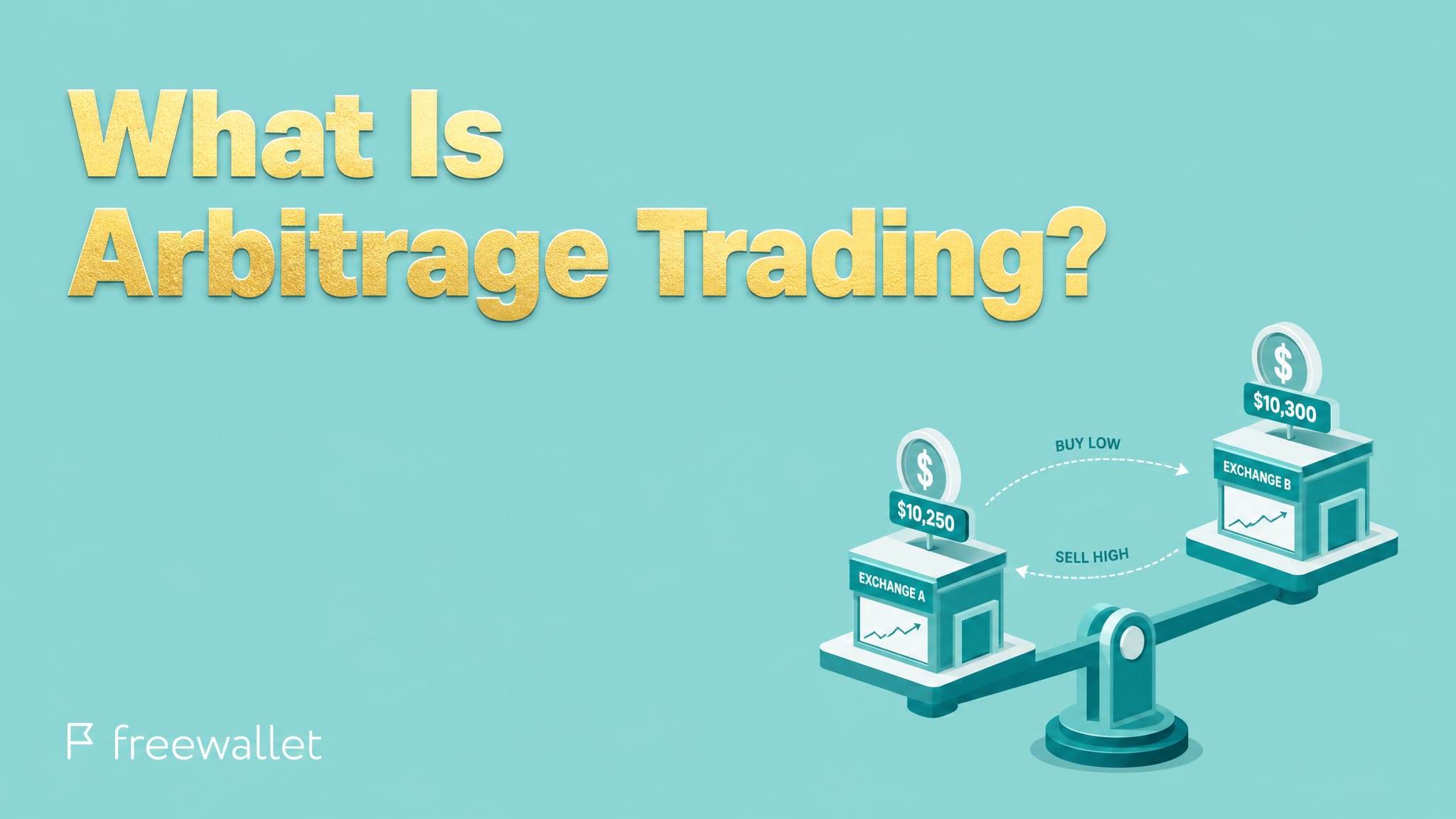
Arbitrage trading is a strategy based on price differences. To put it simply, a trader can purchase a certain asset in one place where the cost is lower and sell this asset in another location with higher prices. In crypto, it might occur between exchanges, pairs, blockchains, or liquidity pools. If you would like to learn about how digital assets transfer across Web3 ecosystems, you are welcome to download the Freewallet Web3 Wallet app and explore non-custodial asset management and trading.
Arbitrage trading is not a new concept. Such a trading model exists since the appearance of stock markets, commodities, foreign exchange, and other markets. However, the distinctive feature of crypto arbitrage trading is the unique conditions in the crypto sector.
Since crypto markets operate 24/7 across different platforms, sometimes prices do not fully match. This may lead to the occurrence of opportunities for crypto arbitrage, though it depends on the number of fees, trading speed, liquidity, and slippage.
Crypto Arbitrage Trading Definition
The process of taking advantage of the existing price difference between different crypto markets is called crypto arbitrage trading. For example, the cost of one Bitcoin on Exchange A can be different from the cost on Exchange B. If a trader can buy this cryptocurrency on Exchange A, then sell on Exchange B, this way, a trader can make some profit from the gap.
As you can see, the concept seems easy, yet in reality, it can be challenging. There are trading fees, withdrawal fees, slow deposits or withdrawals, blockchain confirmation time, liquidity limitations, and price changes at the moment of execution.
It is possible to perform arbitrage trading manually, however, most opportunities appear quickly and cannot be used by a person due to automation. Therefore, in most cases, traders use special programs, bots, or systems for arbitrage trading.

Difference between Crypto Arbitrage Trading and Other Arbitrage Strategies
The difference between crypto arbitrage trading and other types of arbitrage lies in market specifics. While traditional arbitrage occurs in mature and regulated markets, crypto arbitrage is based on more fragmented markets with dozens or even hundreds of centralized and decentralized exchanges, various tokens, liquidity, regions, users, and other variables.
Moreover, in traditional markets, there are professional systems for trade settlement. In crypto, traders can experience difficulties with asset settlement since the process requires moving assets on-chain and confirming them on the network.
Opportunities to Make Arbitrage Trading Possible in Crypto Markets
The main reason for the occurrence of price gaps in crypto markets is the lack of synchronization in these markets. Although thousands or millions of people are actively trading digital assets, every single platform has its own separate liquidity level with supply and demand. If the buying pressure increases on Exchange A compared to other exchanges, it may lead to higher prices in this venue.
Several reasons contribute to the existence of price differences:
– Liquidity differences in different platforms;
– Regional demand and local payment methods;
– Deposits or withdrawals that take time;
– Blockchain congestions;
– Listing differences in different venues;
– Volatility in fast-changing markets.
Thus, arbitrage is considered a positive factor in improving market efficiency since arbitrage traders try to buy and sell assets in places where the cost is lower or higher. By doing this, traders push prices towards normalization.
How Does Crypto Arbitrage Trading Process Work? Step-by-Step
The process of performing arbitrage is similar for any crypto assets and venues, however, the actual process may vary according to your needs and opportunities.
First of all, traders check prices of the same asset across different platforms using special tools. Next, a trader confirms whether he or she can use this arbitrage opportunity in practice. For example, a trader cannot perform arbitrage trading on limited liquidity since there may be not enough assets at the current prices.
The general process of arbitrage trading is the following:
– Find the same asset on different exchanges;
– Calculate prices, fees, and liquidity;
– Confirm availability of withdrawal, deposit, or internal balance;
– Make buy and sell orders;
– Calculate results.
The last step in this list is vital to understand that crypto arbitrage should be evaluated according to results and not the existing difference.
Types of Arbitrage Strategies in Cryptocurrency Markets
There are different types of arbitrage that traders can use. Below, we offer brief descriptions of these strategies:
– Spatial arbitrage – the process of buying assets on one exchange and selling them on another platform;
– Triangular arbitrage – the use of different trading pairs;
– Statistical arbitrage – making bets on price changes based on historical data and models.

Arbitrage Trading in Derivative Markets: Cash-and-Carry and Funding Rate Strategies
Derivative markets give additional opportunities for arbitrage trading since derivatives trade in parallel with spot assets but may have a different price. In case of futures and perpetual futures markets, traders can perform a cash-and-carry strategy. This strategy implies buying of the underlying asset on the spot market and selling futures.
In case of perpetual futures, traders need to take into account the funding rate. Since perpetual futures have no expiration date, exchanges pay users in case of a difference in the prices of futures and spot markets. According to the CFTC, the commission has described virtual currency derivatives and instruments as crypto derivatives and virtual currencies.
As mentioned above, this strategy carries some risks due to changes in funding rates or execution errors. Moreover, perpetual futures can be subject to sudden price changes leading to liquidations.
Arbitrage on DEX and AMM Protocols
DEX arbitrage trading differs from traditional arbitrage. As it was mentioned above, the process is based on price differences on different markets. In the case of DEXes, traders can earn on a price difference between the pool and external markets.
According to Uniswap, automated market makers, also known as AMM protocols, consist of liquidity pools where assets are traded. If traders buy or sell the asset and the price of this asset in the pool differs from prices on other venues, traders can buy and sell the asset for this price.
Despite being beneficial for decentralization, AMM arbitrage requires consideration of additional factors. For example, traders face gas fees and potential smart contract risks.
The CFTC has explained maximal extractable value (MEV) as extra fees that go to miners or validators for creating blocks. As the Ethereum.org stated, arbitrage transactions are one of the activities associated with MEV.
Cryptocurrency Arbitrage Trading Bots and Tools
Most people who engage in arbitrage trading use bots. Bots allow tracking price changes in multiple markets. Moreover, bots are able to analyze prices, identify potential opportunities, and place orders.
Main types of software that traders can use for arbitrage purposes:
– Exchange price scanners;
– Trading bots using API integration;
– Portfolio and balance monitor;
– DEX routing tools;
– Gas fee tracker.
It is worth considering that bots are just software and, therefore, they can provide incorrect results. Bots require configuration that can be performed incorrectly by inexperienced users.
Furthermore, bots may require authorization of the account through API which brings potential security risks to arbitrage traders.
Is Cryptocurrency Arbitrage Trading Profitable? Fees and Slippage
The answer to this question varies depending on many factors. In order to evaluate profitability, it is necessary to assess all expenses. The main fees traders face are trading fees, spread costs, withdrawal fees, network fees, bridging fees, and others.
In case of AMM protocol arbitrage, the main cost is the gas fee that depends on network congestions. During peak activity of exchanges and users, the gas fees rise and make profits impossible.
Slippage is another essential aspect traders need to take into account. Slippage appears due to the difference between the initial bid and final execution prices. This is a significant issue in low liquidity situations when even a small purchase moves prices.
Factors to be considered in the calculation of arbitrage trade profitability:
– Buy price and sell price;
– Fees on each platform;
– Network or withdrawal fees;
– Expected slippage;
– Transaction time;
– Tax and reporting requirements.
Thus, an arbitrage trade that seems profitable initially may lead to losses if the trader does not consider all possible aspects.

Important Aspects of Risk Management in Crypto Arbitrage Trading
Even though arbitrage is a less risky form of trading than speculative trading, this type of trading still involves some risks. First of all, traders may face execution risk because prices can change significantly before completing the transaction. Another important risk is the platform risk. It means delays of withdrawal processes or restrictions on deposits or other services.
The risk of hacking or other security issues is also relevant. For example, many traders store assets on different exchanges. However, it raises the risk of a hack or theft since each service can have some bugs.
Another important point is regulatory risks and taxes. Depending on your country, you should comply with the laws regarding crypto trading. In particular, custody of assets involves some specific risks as mentioned by the SEC investor education materials.
Role of Arbitrage Trading in Improving Market Efficiency
One of the important functions of arbitrage trading is making markets more efficient. Since arbitrage traders react to price changes and buy cheap assets or sell expensive ones, traders push assets’ prices in one direction.
In crypto, market efficiency is important due to the lack of consolidation and fragmentation. In addition, arbitrage traders connect various venues like DEXes, CEXes, derivative platforms, and regional exchanges.
However, as we stated above, market efficiency does not mean equal benefits for all participants. The most experienced traders have an advantage due to faster speed, more liquidity access, lower fees, and better technology.
FAQs
What is crypto arbitrage trading in simple terms?
Crypto arbitrage is the process of earning profits on price differences between exchanges or other venues. A trader buys assets on one side of the market where the cost is lower and sells them on the other side where the cost is higher.
Is it safe to engage in arbitrage trading in cryptocurrencies?
It may seem quite easy, however, this type of trading involves many risks. Among the main risks are price changes, errors, technical problems, high fees, liquidity limitations, and other issues.
Which arbitrage trading is the most popular?
The most common type of crypto arbitrage is spatial arbitrage. In this situation, a trader buys assets on one exchange and sells assets on another exchange.
What is triangular arbitrage?
The main characteristic of triangular arbitrage is that traders use different trading pairs. The process begins with one cryptocurrency and ends with this cryptocurrency, though the trader has more coins of this cryptocurrency after the process.
Why do prices differ between exchanges in crypto?
Prices can be different due to different users, liquidity, deposits or withdrawals, blockchain congestion, listing, volatility, and other variables.
Is it possible to make arbitrage on decentralized exchanges?
Yes, it is possible since prices of assets on liquidity pools may differ from prices on other liquidity pools or exchanges.
Are crypto arbitrage bots profitable?
No, bots are just helpful to complete arbitrage transactions. Thus, there is still a chance that bots will make incorrect decisions or calculations.
Is arbitrage trading convenient for beginners?
Beginners can learn about this topic, yet, there are many challenges they need to face.
How does arbitrage improve market efficiency?
As a result of arbitrage, the price on the cheaper market increases while the price on the expensive market decreases. Thus, arbitrage leads to more equal prices.
Related


Stay tuned
Subscribe for weekly updates from our blog. Promise you will not get emails any more often.
Our authors

Most Popular
New Posts
Stay tuned
Subscribe for weekly updates from our blog. Promise you will not get emails any more often.
Our authors